





Brick sizes

Contents |
[edit] Introduction
There are many different types of brick available, and it is important to both choose your bricks wisely and also check their dimensions to ensure they fit with the design layout.
This article presents a size guide for some of the most commonly-used bricks.

|

|

|
[edit] What size are standard bricks?
The standard co-ordinating size for brickwork is 225 mm x 112.5 mm x 75 mm (length x depth x height). This includes 10 mm mortar joints, so the standard size of a brick itself is 215 mm x 102.5 mm x 65 mm (length x depth x height).
This gives a ratio of 3:2:1, meaning that:
- With a standard mortar joint of 10 mm, a repeating unit of bricks laid in a stretcher bond will be 225 mm lengthwise and 75 mm in height.
- If bricks are laid cross-wise, two 102.5 mm depths plus two mortar joints gives the same repeating unit as the length of one brick plus one mortar joint, i.e. 225 mm.
- If they are laid height wise, three 65 mm heights plus three mortar joints gives the same repeating unit as the length of one brick plus one mortar joint, i.e. 225 mm.
This makes it straight-forward to create complex patterns of bricks within the standard co-ordinating size. See Types of brick bonding for more information.
60 standard bricks laid in a stretcher bond (lengthwise) are required for every square meter of wall.
[edit] What sizes are non-standard bricks?
A list of common brick sizes and their characteristics is set out below:
| Type | Characteristics | Imperial length x depth x height | Metric length x depth x height (mm) |
| Blocks | Constructed using concrete or cement. They may include a hollow core to make them lighter and to improve their insulation. | 440 x (varies) x 215 | |
| Modular | Commonly used for the construction of buildings and homes. | 7-5/8" x 3-5/8" x 2-1/4" | 194 x 92 x 57 |
| Jumbo modular | 7-5/8" x 3-5/8" x 2-3/4" | 194 x 92 x 70 | |
| Queen | Slightly smaller and more cost effective than a modular brick. | 9-5/8" x 3-1/8" x 2-3/4" | 244 x 79 x 70 |
| King | 9-5/8" x 2-3/4" x 2-5/8" | 244 x 76 x 67 | |
| Engineer | Used where strength and water/frost resistance are required. Very sturdy and reliable to use. | 7-5/8" x 3-5/8" x 2-13/16" | 194 x 92 x 71 |
| Closure | Used to finish off a wall, especially at the corners | 7-5/8" x 3-5/8" x 3-5/8" | 194 x 92 x 92 |
| Norwegian | Substantial bricks that can be used in load-bearing walls while still looking good. They have a natural beauty to them. | 11-5/8" x 3-5/8" x 2-13/16" | 295 x 92 x 71 |
| Monarch | Commonly used for long stretches of wall and are very strong. | 15-5/8" x 3-5/8" x 3-5/8" | 397 x 92 x 92 |
| Utility | Very versatile and can be used for a range of construction projects. | 11-5/8" x 3-5/8" x 3-5/8" | 295 x 92 x 92 |
| Norman | These are classic industrial bricks for construction projects and commonly come in red or white. | 11-5/8" x 3-5/8" x 2-1/4" | 295 x 92 x 57 |
| Roman | 11-5/8" x 3-5/8" x 1-5/8" | 295 x 92 x 41 | |
| Quad | 7-5/8 x 3-5/8" x 7-5/8" | 194 x 92 x 194 | |
| Danish hand mould | 7-5/8" x 3-5/8" x 2-1/4" | 194 x 92 x 57 | |
| Meridian | 15-5/8" x 3-5/8" x 3-5/8" | 397 x 92 x 92 | |
| Ambassador | 15-5/8" x 3-5/8" x 2-1/4" | 397 x 92 x 57 |
Note, there may be some variation in these sizes through history and from one supplier to another.
[edit] What are special bricks?
Other than the standard rectangular bricks, a number of special shapes exist for particular circumstances:
- Radial, tapered or arch bricks.
- Angle and cant bricks that form returns and chamfers.
- Bullnose bricks with rounded corners.
- Capping and coping bricks.
- Cill bricks.
- Plinth bricks.
- Slip bricks (thin bricks that can be used for cladding).
- Soldier bricks, that form returns for soldier courses.
Bricks can also be cut or hand made to size.
This article was originally created by --Specified
It has subsequently been edited by others - See full history for more information.
[edit] Related articles on Designing Buildings
IHBC NewsBlog
IHBC sponsors Gardens Trust event 23-4 Sept 2026
.jpeg)
'Learning from the Past, Shaping the Future’ takes place in Milton Keynes
Renovations to Frank Lloyd Wright's Fallingwater complete
.jpg)
World Heritage Preserved project opens house for tours again
Shakespeare Birthplace Trust places Hall's Croft on HAR Register
Stratford-upon-Avon home of Shakespeare's daughter is 'At Risk'
Lady Grange’s House repaired on St Kilda
.jpg)
National Trust for Scotland repairs stone cleit with link to famous island resident
Griff Rhys Jones on BBC Radio 4 Today programme
,_Green_Lane,_Derby.jpg)
The Victorian Society’s President unveiled its latest Top Ten Endangered Buildings 2026.
Need a MATE? Book your place now.

IHBC offers free webinars on applying for IHBC accreditation (Full & Associate).
UK Stained Glass Repository finds windows new homes
How are stained glass windows are rescued, stored and repurposed?
APPGEBE report sets high aims for quality
'Government must not sacrifice quality in drive to build 1.5m homes'
New measures protect Historic Shipwrecks from heritage crime

Underwater cultural heritage benefits from new HE guidance
How could the City of London skyline look in 6 years' time?

Visualisation shows approved planning applications as completed buildings
National Trust for Scotland calls for VAT cuts
Heritage neglect is encouraged by current policies
IHBC's 'Context' Issue 186 features Industrial Heritage

IHBC's members' journal reports on the challenges of conserving infrastructure
Book now for IHBC Annual School 2026

IHBC Annual School is taking place 18-20 June 2026 in Newcastle
RICHeS Research Infrastructure offers ‘Full Access Fund Call’

RICHeS offers a ‘Help’ webinar on 11 March
Latest IHBC Issue of Context features Roofing
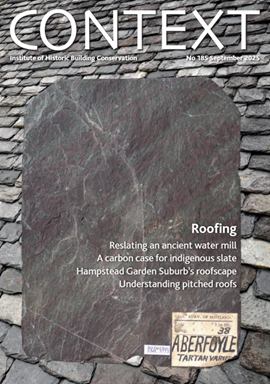
Articles range from slate to pitched roofs, and carbon impact to solar generation to roofscapes
Three reasons not to demolish Edinburgh’s Argyle House

Should 'Edinburgh's ugliest building' be saved?
IHBC’s 2025 Parliamentary Briefing...from Crafts in Crisis to Rubbish Retrofit
IHBC launches research-led ‘5 Commitments to Help Heritage Skills in Conservation’
How RDSAP 10.2 impacts EPC assessments in traditional buildings

Energy performance certificates (EPCs) tell us how energy efficient our buildings are, but the way these certificates are generated has changed.
Comments
[edit] To make a comment about this article, click 'Add a comment' above. Separate your comments from any existing comments by inserting a horizontal line.
Really helpful to have lots of different brick sizes in a single article.